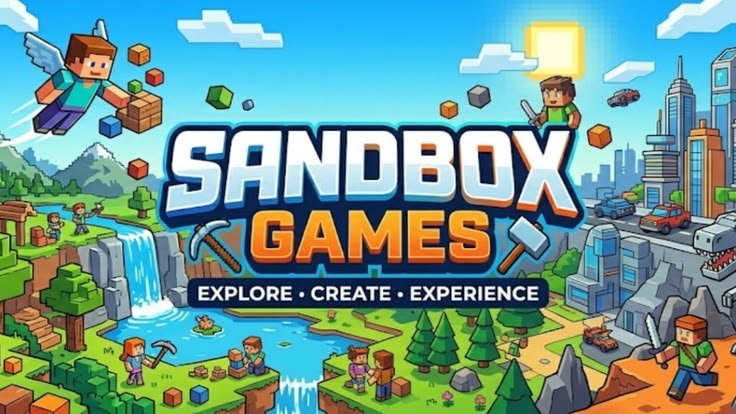

Sandbox games are a type of video game that gives players a high level of freedom to explore, create, experiment, and decide how they want to play. Instead of forcing players to follow one specific path, sandbox games often provide a world filled with different activities and allow players to choose what they want to do.
The word “sandbox” comes from the idea of a real sandbox, where people can create and experiment freely. In video games, the concept works in a similar way. Developers provide the world, tools, systems, and rules, while players decide how to use them.
A sandbox game may include exploration, building, combat, crafting, driving, farming, social activities, missions, or other features. Some sandbox games have clear stories and objectives, while others focus almost entirely on creativity and freedom.
What Makes a Sandbox Game?
The main feature of a sandbox game is player freedom.
Players are usually given a world where they can choose different activities instead of following a single required path.
For example, a player might spend time exploring the environment, collecting resources, building structures, completing missions, customizing a character, or simply experimenting with the game’s systems.
The game may still provide objectives, but players often have considerable freedom in deciding how and when to complete them.
This makes sandbox games different from highly linear games where players usually follow a predetermined sequence of levels.
The History of Sandbox Games
The idea of giving players freedom has existed throughout video game history.
Early games were often limited by hardware, but developers still created experiences where players could experiment with systems and explore virtual spaces.
As computers and consoles became more powerful, developers were able to create larger environments with more interactive objects and characters.
Open-world design also became increasingly common.
Eventually, sandbox games developed into a broad category that could include building games, open-world adventures, simulations, management games, and creative experiences.
Today, sandbox mechanics can be found in many different genres.
Sandbox Games and Open-World Games
Sandbox and open-world games are closely related, but they are not exactly the same thing.
An open-world game mainly describes the structure of the game world. It usually allows players to travel through a large environment without being restricted to a fixed sequence of levels.
A sandbox game focuses more strongly on player freedom and experimentation.
A game can be open-world without being a true sandbox if players still have limited ways to interact with the environment.
Likewise, some sandbox experiences may take place in smaller environments.
The two concepts often overlap, but they describe different aspects of game design.
Player Freedom
Player freedom is one of the biggest attractions of sandbox games.
Players can often decide what they want to accomplish.
One player may focus on completing missions, while another may spend hours building structures or exploring.
This freedom can make the same game feel different for different players.
There may be no single correct way to experience the game.
Exploration
Exploration is common in sandbox games.
Players may be given large environments containing cities, forests, mountains, oceans, underground areas, buildings, and other locations.
Exploration can reveal new resources, activities, characters, locations, and secrets.
Some sandbox games encourage players to explore by placing useful materials or interesting locations throughout the world.
Others simply provide a large environment and allow players to decide where they want to go.
Building and Construction
Building is one of the most recognizable sandbox mechanics.
Some sandbox games give players tools that allow them to construct houses, cities, farms, machines, roads, castles, or other structures.
Players can use different materials and designs to create unique projects.
Building systems can range from simple placement tools to highly detailed construction mechanics.
Creative players can spend large amounts of time designing their own environments.
Crafting Systems
Crafting is another common feature.
Players may collect resources and combine them to create useful objects.
These objects can include tools, furniture, equipment, decorations, vehicles, or building materials.
Crafting gives players another reason to explore the environment.
Instead of simply collecting items, players can use them to create something useful.
Creativity
Sandbox games often give players opportunities to express their creativity.
A player might design a unique building, create an unusual vehicle, build an automated machine, or organize an entire virtual community.
The game provides the tools, but the player determines what to create.
This is one reason sandbox games can appeal to players who enjoy creativity as much as traditional competition.
Physics and Game Systems
Some sandbox games are built around physics.
Objects may move, fall, collide, break, or interact with one another according to the game’s physics system.
Players can experiment with these systems to see what happens.
For example, they might build structures, move objects, create machines, or test different combinations of items.
Physics-based sandbox games can be especially entertaining because players can discover unexpected results.
Non-Linear Gameplay
Sandbox games are often non-linear.
This means players do not necessarily have to complete objectives in a specific order.
They may be able to choose which missions to complete, which areas to explore, or which activities to focus on.
This gives players greater control over their experience.
Non-linear design can also encourage replayability because players can approach the game differently each time.
Missions and Side Activities
Sandbox games can still include missions.
A large open world might contain main missions, side missions, races, challenges, collectibles, and other activities.
Players can decide which activities they want to complete.
Some missions may be connected to the main story, while others exist simply to provide additional gameplay.
This combination of freedom and structured objectives is common in modern sandbox games.
Character Customization
Many sandbox games allow players to customize their characters.
Customization can include clothing, hairstyles, accessories, equipment, skills, abilities, and other features.
Some games allow players to create characters from the beginning.
Others provide a predefined character but offer many customization options during the game.
Customization allows players to make their virtual characters feel more personal.
Vehicle Systems
Vehicles can play an important role in some sandbox games.
Players may be able to drive cars, ride motorcycles, fly aircraft, sail boats, or use other forms of transportation.
Vehicles can make large environments easier to explore.
Some games also allow players to customize or upgrade vehicles.
Vehicle systems can create additional gameplay opportunities beyond the main missions.
Sandbox Games and Simulation
Sandbox games can overlap with simulation games.
A sandbox simulation may allow players to control cities, businesses, farms, characters, vehicles, or other systems.
Instead of following a strict storyline, players may be given tools and allowed to experiment.
For example, a city-building sandbox can allow players to design a city and manage its development.
A life simulation sandbox may allow players to control characters and their daily activities.
Multiplayer Sandbox Games
Sandbox games can also be multiplayer experiences.
Several players may share the same world and work together on projects.
They might build structures, explore environments, collect resources, complete missions, or create communities.
Multiplayer sandbox games can make large projects easier because multiple players can contribute.
They can also create social experiences where players interact, communicate, and share ideas.
Creative Modes
Some sandbox games provide separate creative modes.
A creative mode may give players unlimited resources or remove many restrictions.
The goal is usually to allow players to focus entirely on building and experimentation.
Players can create large structures without spending time collecting every material.
Creative modes are particularly popular with players who enjoy designing and building.
Survival Sandbox Games
Other sandbox games combine freedom with survival mechanics.
Players may need to collect resources, build shelters, manage food, craft equipment, and explore dangerous environments.
This creates a balance between creativity and challenge.
Players may build impressive structures while still needing to manage the basic requirements of survival.
Procedural Generation
Some sandbox games use procedural generation to create parts of their worlds.
Instead of manually designing every area, developers create systems that generate environments using rules and algorithms.
This can produce large or varied worlds.
Procedural generation can also increase replayability because different players may encounter different environments.
Modding and User-Created Content
Modding is especially important to many sandbox games.
Mods can add new objects, characters, environments, vehicles, gameplay systems, or visual changes.
Some games also provide official tools that allow players to create their own content.
This can greatly expand the possibilities of a sandbox game.
A strong community can continue creating new experiences long after the original game was released.
User-Generated Worlds
Some sandbox platforms allow players to create entire experiences for other players.
Instead of simply playing content created by the game’s developers, users can design their own maps, games, challenges, or virtual spaces.
Other players can then visit and interact with those creations.
This turns the game into a platform for creativity as well as entertainment.
Emergent Gameplay
Emergent gameplay occurs when players create unexpected situations through the interaction of game systems.
Developers may not have planned every possible situation.
Instead, the game’s rules allow different systems to interact in interesting ways.
For example, players might combine vehicles, physics, environmental objects, and other mechanics to create situations that were not specifically designed as missions.
This unpredictability can make sandbox games feel different every time they are played.
Storytelling in Sandbox Games
Sandbox games can use different approaches to storytelling.
Some provide a strong main story with characters and missions.
Others use environmental storytelling and allow players to discover information while exploring.
Some sandbox games provide very little traditional storytelling and allow players to create their own stories through their actions.
This flexibility makes the genre suitable for many different experiences.
Progression in Sandbox Games
Sandbox games can include different types of progression.
Players may unlock new equipment, abilities, areas, vehicles, construction materials, or crafting recipes.
Some games use experience levels, while others simply provide new tools as players complete objectives.
Progression gives players reasons to continue exploring and experimenting.
Replayability
Sandbox games often have high replay value because players can approach them in different ways.
A player might focus on building during one playthrough and exploration during another.
Different choices, custom creations, multiplayer interactions, and procedural worlds can also create new experiences.
Because the player has significant freedom, there may be many things to discover even after completing the main objectives.
Why Sandbox Games Are Popular
Sandbox games are popular because they give players control over their experience.
Some people enjoy completing missions and following stories.
Others prefer building, experimenting, exploring, or creating.
Sandbox games can support all of these play styles.
They can also provide long-lasting entertainment because players are not always limited to developer-created objectives.
The ability to create something unique can make players feel like active participants rather than simply people following instructions.
Sandbox Games on Different Platforms
Sandbox games are available on consoles, computers, mobile devices, and other platforms.
PC gaming is particularly important for sandbox experiences because computers can support extensive modding and user-created content.
Consoles also provide many sandbox experiences, often with optimized controls and multiplayer features.
Mobile devices have introduced sandbox mechanics to a wider audience through games designed for touch controls and shorter play sessions.
The Future of Sandbox Games
The future of sandbox games is likely to involve even greater levels of freedom and interaction.
More powerful hardware can allow developers to create larger and more detailed worlds.
Artificial intelligence could make characters and virtual environments more responsive to player actions.
Improved physics systems could create more realistic interactions between objects.
User-generated content may also become more advanced, allowing players to create increasingly complex worlds and experiences.
Virtual reality could provide another way to interact with sandbox environments, while online technology can connect larger communities of players.
Sandbox games have become an important part of modern gaming because they give players freedom to explore, build, create, experiment, and decide how they want to play. Rather than providing only one fixed experience, sandbox games can become platforms where players create their own goals and discover unexpected possibilities through the systems provided by the developers.