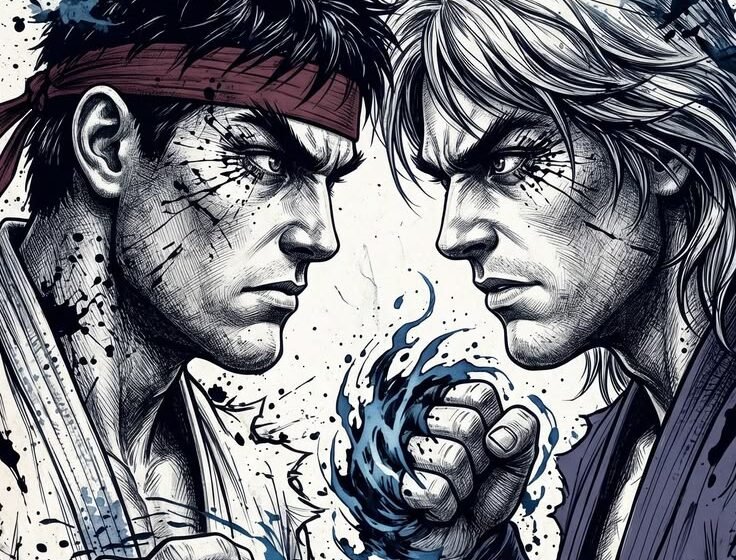

Fighting games are a popular genre of video games that focus on battles between characters. Players control fighters with different abilities, attacks, movement styles, and special techniques while competing against another character.
Unlike many action games where players fight groups of enemies while progressing through a story, fighting games usually place two or more characters directly against each other in a controlled battle. The objective may be to reduce an opponent’s health, win a certain number of rounds, or complete another combat-related challenge.
Fighting games are known for fast reactions, precise controls, character variety, special moves, combos, and competitive multiplayer. They can be easy to understand at a basic level but can become very deep when players begin learning advanced techniques.
What Makes a Fighting Game?
The main feature of a fighting game is direct combat between playable characters.
A typical match places two fighters in an arena. Each character has a health bar, and players use controls to move, attack, defend, and perform special moves.
A match is usually divided into rounds. A player who wins enough rounds becomes the winner of the match.
Different fighting games use different rules. Some focus on hand-to-hand combat, while others include weapons, supernatural abilities, projectiles, or other special mechanics.
Despite these differences, the central idea remains the same: players control characters and compete directly against opponents.
The History of Fighting Games
Fighting games have existed for many years, but the genre became especially popular during the arcade era.
Early fighting games experimented with direct character-versus-character competition. As arcade hardware improved, developers were able to create more detailed characters, smoother animations, and more responsive controls.
The genre grew significantly during the late 1980s and early 1990s. Arcades became important social spaces where players could challenge friends and strangers.
Fighting games eventually moved to home consoles and personal computers. This allowed players to practice at home and compete with others without needing to visit an arcade.
Over time, online multiplayer transformed the genre again by allowing players from different locations to compete through the internet.
One-on-One Battles
Traditional fighting games often use one-on-one battles.
Two players select their characters and enter an arena. They then attempt to defeat each other before the time limit expires.
One-on-one battles make it easier for players to understand what is happening because the match focuses directly on two characters.
They also make individual skill very important.
Players need to understand their own character while also learning how opponents behave.
Health Bars and Rounds
Most fighting games use health bars to show how much damage each character can take before losing a round.
Attacks reduce an opponent’s health, while successful defense can prevent or reduce damage.
A timer may also appear on the screen. If neither player defeats the other before time runs out, the game uses its rules to determine the winner.
Many games divide matches into multiple rounds.
Winning one round does not necessarily mean winning the entire match. Players may need to win several rounds before the match is complete.
Character Selection
Character selection is one of the most important parts of fighting games.
A game may contain a small number of fighters or a very large roster.
Each character can have different strengths, weaknesses, movement styles, attacks, and special abilities.
One fighter may be fast and agile, while another may be slower but stronger.
Some characters may specialize in close-range attacks, while others may be better at controlling distance.
This variety allows players to find characters that match their preferred style.
Character Abilities
Fighting game characters often have unique abilities.
These can include powerful attacks, defensive techniques, special moves, projectiles, grabs, counters, or movement abilities.
Learning these abilities is an important part of becoming familiar with a character.
Players often spend time practicing how and when to use different attacks.
Knowing an ability is useful, but understanding the correct situation for using it can be even more important.
Combos
Combos are a major feature of many fighting games.
A combo occurs when a player connects several attacks together in a sequence that the opponent has limited or no opportunity to interrupt.
Combos can range from simple combinations that are easy to perform to complicated sequences requiring precise timing.
Learning combos can help players become more effective with their chosen character.
However, fighting games are not only about memorizing long combinations. Movement, defense, timing, positioning, and decision-making are also important.
Blocking and Defense
Attacking is only one part of fighting.
Players also need to know how to defend themselves.
Blocking can reduce or prevent damage from certain attacks. Some games also include different types of defensive techniques.
Players may need to recognize an opponent’s attack and react quickly.
Good defense can create opportunities to counterattack.
This creates a balance between offense and defense that makes fighting games more strategic than they may appear at first.
Special Moves
Many fighting games include special moves that are performed using specific button combinations or controller inputs.
These moves may produce powerful attacks, projectiles, defensive effects, or unusual movement.
Some special moves can be easier to perform, while others require more precise timing.
Players often practice these inputs until they can perform them consistently during a real match.
Super and Powerful Attacks
Some fighting games include powerful attacks that require players to build a special meter.
The meter may increase as players attack, defend, receive damage, or perform certain actions.
Once enough energy has been collected, a player may be able to perform a powerful special attack.
These mechanics can add another layer of decision-making.
Players must decide whether to use their stored energy immediately or save it for a later opportunity.
Different Types of Fighting Games
There are several different styles of fighting games.
Traditional two-dimensional fighting games usually place characters on a mostly horizontal plane. Players move left and right while jumping, attacking, blocking, and performing special moves.
Three-dimensional fighting games allow characters to move around the arena in more directions. Positioning and movement can therefore play a larger role.
Platform fighting games use platforms and larger arenas. Instead of simply reducing an opponent’s health, the goal may involve knocking characters out of the fighting area.
There are also team-based fighting games where players select multiple characters and switch between them during battles.
Each style creates different gameplay experiences.
Team-Based Fighting
Not every fighting game is limited to one character per player.
Some games allow players to build teams of fighters.
A player might select several characters and switch between them during a match.
Different characters can serve different roles.
One character may be useful for dealing damage, while another may provide better defensive options or assist with controlling space.
Team systems add another layer of strategy because players must consider how their characters work together.
Stages and Arenas
Fighting games take place in arenas or stages.
A stage can be a simple platform, a city street, a building, a stadium, a forest, or a fictional environment.
Some games use mostly flat arenas where the environment has little effect on combat.
Other games include interactive stages with objects, hazards, multiple levels, or special features.
Stage design can affect how players move and where they position themselves during a match.
Movement and Positioning
Movement is extremely important in fighting games.
Players need to understand how quickly their character can move and how much space different attacks cover.
Positioning can determine whether an attack connects or misses.
Players may try to stay at a distance where their attacks are effective while avoiding the opponent’s strongest moves.
Advanced players often pay close attention to spacing and movement.
Timing and Reaction
Fighting games require players to make decisions quickly.
A player may need to react to an incoming attack, recognize an opponent’s movement, block at the correct moment, or immediately respond after an attack misses.
Timing is especially important because many attacks have specific periods during which they can be used safely or punished.
As players gain experience, they often become better at recognizing patterns and reacting to situations.
Fighting Game Controls
Fighting games are designed around precise controls.
Players may use a traditional game controller, keyboard, arcade-style controller, or other input device.
Some players prefer specialized fighting game controllers because they provide buttons and directional controls designed specifically for fighting games.
However, players can use different control methods depending on the game and platform.
The most important factor is usually being comfortable and consistent with the chosen controls.
Single-Player Modes
Fighting games are not only about playing against other people.
Many include single-player modes where players fight computer-controlled opponents.
A story mode may take players through a series of battles while revealing information about the characters and fictional world.
Arcade modes can provide a sequence of opponents that players must defeat.
Other modes may include survival challenges, training challenges, time-based events, or special battles.
These modes allow players to practice and enjoy the game without needing another human opponent.
Training Mode
Training mode is especially useful in fighting games.
Players can enter a practice environment where they can test attacks, combos, movement, and defensive techniques.
Training modes often allow players to control how the computer-controlled character behaves.
For example, the opponent may stand still, block, attack, or repeat a specific action.
This gives players a controlled environment for learning how the game’s mechanics work.
Online Multiplayer
Online multiplayer has become an important part of modern fighting games.
Players can connect to the internet and compete against people from different locations.
Online modes can include casual matches, ranked matches, tournaments, and private matches with friends.
Ranked systems may track player performance and match people against opponents according to the game’s matchmaking system.
Online competition has helped create large communities around fighting games.
Competitive Fighting Games
Fighting games have become an important part of competitive gaming.
Players can compete in organized tournaments where matches are played under specific rules.
Competitive players often spend significant amounts of time practicing their chosen characters, studying opponents, learning matchups, and improving their reactions.
Tournaments can take place online or at physical events.
The competitive scene has also helped introduce fighting games to larger gaming audiences.
Matchups
A matchup describes the relationship between two characters or play styles.
Some characters may have advantages against certain opponents because their abilities work particularly well against them.
Players therefore need to understand more than just their own character.
They may also study the strengths and weaknesses of other characters.
This can become particularly important in competitive play.
Learning a Fighting Game
Fighting games can look complicated when a new player first starts playing.
There may be many characters, attacks, special moves, combos, and mechanics to learn.
However, beginners do not need to master everything immediately.
Learning basic movement, attacking, blocking, and a few useful moves can provide a foundation.
Players can then gradually learn more advanced techniques as they become comfortable.
Practice is an important part of improving.
Why Fighting Games Are Popular
Fighting games are popular because they provide direct competition and clear objectives.
Players can quickly understand the basic goal of a match, but the depth of the gameplay can keep experienced players interested.
Character variety also gives players many ways to approach the game.
Some people enjoy learning one character deeply, while others like experimenting with different fighters.
The short length of many matches also makes fighting games convenient for quick gaming sessions.
The Social Side of Fighting Games
Fighting games have traditionally had a strong social element.
Arcades once allowed players to challenge people standing nearby.
Today, online multiplayer provides a similar opportunity on a much larger scale.
Friends can play private matches, communities can organize tournaments, and players can share strategies and gameplay clips online.
This social environment has helped fighting games remain an active part of gaming culture.
Graphics and Animation
Character animation is particularly important in fighting games.
Players need to be able to recognize attacks and movements quickly.
Clear animations can help players understand what their opponent is doing.
Modern hardware has allowed developers to create highly detailed characters, environments, visual effects, and animations.
However, visual quality is not the only important factor. Responsiveness and clarity are also essential because players need to understand what is happening during fast battles.
Fighting Games on Different Platforms
Fighting games are available on many platforms.
Consoles have traditionally been important platforms for the genre, while PC gaming has also become a major part of the fighting game community.
Mobile devices have introduced fighting-style games to another large audience.
Different platforms can provide different control options, graphics, and online features.
Cross-platform play can also allow players using different devices to compete against one another when supported by the game.
The Future of Fighting Games
Fighting games will likely continue developing alongside gaming technology.
Improved online systems can make multiplayer matches more stable and accessible.
Better training tools can help new players understand game mechanics more easily.
Artificial intelligence may also provide more advanced practice opponents that can respond to individual player behavior.
Improved graphics and animation can make characters and environments more detailed while maintaining responsive controls.
Virtual reality could also create new possibilities for fighting games, although traditional controller-based fighting remains well suited to the precise inputs required by the genre.
Fighting games have grown from simple arcade competitions into a diverse genre featuring character customization, complex combat systems, story modes, online multiplayer, competitive tournaments, and large gaming communities. Whether someone enjoys casual matches with friends or spends time learning advanced techniques, fighting games offer many different ways to experience competitive gameplay.