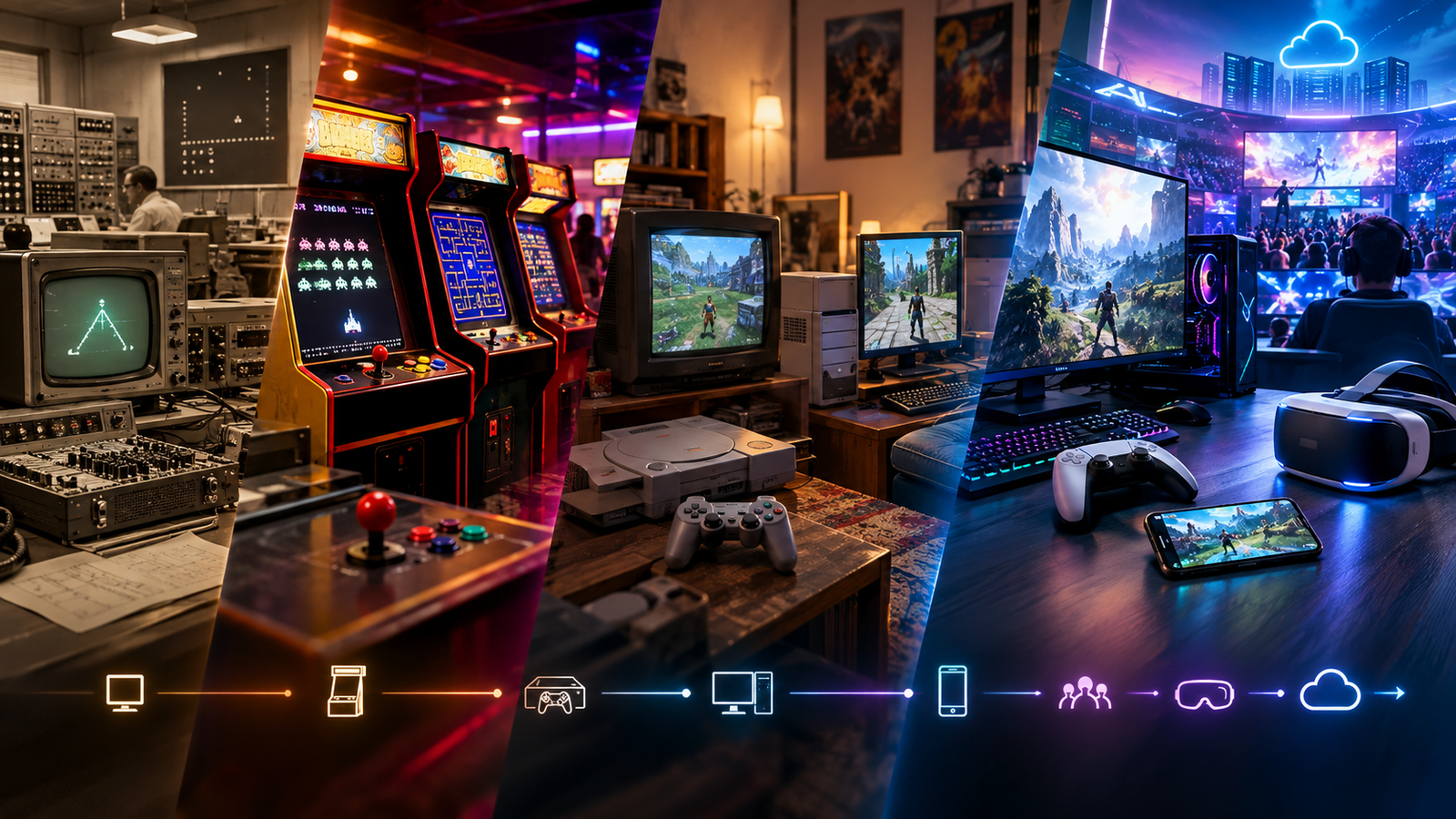

Video games have become one of the most popular forms of entertainment in the world. Today, people play games on smartphones, computers, gaming consoles, tablets, and virtual reality devices. Some games are simple and can be played in a few minutes, while others contain huge worlds, detailed characters, complex stories, and millions of players.
But video games did not begin with modern consoles, powerful gaming PCs, or smartphones. Their history goes back several decades, when computers were large, expensive machines mainly used by scientists, universities, and governments.
Over time, video games developed from simple experiments into a massive global industry. Technology improved, game design became more advanced, and the way people played and interacted with games changed dramatically.
The Early Beginnings of Video Games
The earliest history of video games can be traced to experiments with computers and electronic displays during the 1940s and 1950s.
At that time, computers were very different from the machines we use today. They were extremely large, expensive, and difficult to operate. They were mainly designed for calculations and scientific research.
Scientists and engineers eventually discovered that computers could do more than calculate numbers. They could also be programmed to create interactive experiences.
One early example was Nimrod, a computer demonstrated in 1951. It was designed to play the mathematical game Nim. Although it was not a video game in the modern sense, it demonstrated that electronic computers could be used for games.
In 1952, British computer scientist Alexander S. Douglas created OXO, a computer version of tic-tac-toe. The game ran on the EDSAC computer at the University of Cambridge and displayed the game on a screen.
Another important development came in 1958 when physicist William Higinbotham created Tennis for Two. The game simulated a simple tennis match and was displayed on an oscilloscope. Two people could interact with the game using controllers.
These early projects helped introduce an important idea: computers could be used for interactive entertainment.
Spacewar! and the Growth of Computer Games
One of the most important early computer games appeared in 1962.
A group of students and researchers at the Massachusetts Institute of Technology developed a game called Spacewar!
The game allowed two players to control spaceships and fight each other in space. Players had to control their ships, fire weapons, avoid attacks, and deal with the gravitational effects of a star.
Spacewar! became influential because it showed what computers could do as interactive entertainment.
Computers were still far too expensive for ordinary people to own, so the game was mainly played by people who had access to universities and research institutions. However, the ideas behind Spacewar! influenced future game developers.
The Birth of Commercial Video Games
The early 1970s marked a major turning point in video game history.
Technology had developed enough for companies to begin creating games specifically for commercial entertainment.
In 1971, Computer Space was released as one of the earliest commercially produced arcade video games. It was created by Nolan Bushnell and Ted Dabney and was inspired by Spacewar!
The game introduced the idea of putting an electronic game inside a dedicated arcade machine.
In 1972, Nolan Bushnell and Ted Dabney founded Atari. The company would eventually become one of the most important names in the early video game industry.
Pong Changes Gaming
One of Atari’s first major successes was Pong, released in 1972.
Pong was a simple electronic game based on table tennis. Players controlled paddles on opposite sides of the screen and attempted to hit a ball past their opponent.
The concept was extremely simple, but the game was easy to understand and enjoyable.
Pong became very popular in arcades and demonstrated that video games could become a successful commercial entertainment business.
Its success encouraged other companies to enter the industry and develop their own games.
The First Home Video Game Console
While arcade gaming was becoming popular, companies were also trying to bring video games into people’s homes.
In 1972, Magnavox released the Magnavox Odyssey, widely considered the first commercially available home video game console.
The system was very different from modern consoles. Its graphics were extremely basic, and some games used physical overlays that were placed on the television screen.
Even with its limitations, the Magnavox Odyssey established an important idea: people could play electronic games at home using their television.
The Golden Age of Arcade Games
During the late 1970s and early 1980s, arcade gaming experienced enormous growth.
One of the most influential games was Space Invaders, released by Taito in 1978.
Players controlled a laser cannon and attempted to defeat waves of alien enemies moving down the screen.
Space Invaders became an international success and helped establish Japan as an important center of video game development.
Other popular arcade games followed, including Asteroids, Galaxian, Defender, and Frogger.
Arcades became popular social spaces. People could compete for high scores, challenge friends, and watch other players.
Video games were becoming a major form of entertainment rather than simply a technological experiment.
Pac-Man Becomes a Global Icon
In 1980, Namco released Pac-Man.
The game was very different from many popular arcade games at the time. Instead of controlling a spaceship and shooting enemies, players controlled a yellow character moving through a maze while eating dots and avoiding ghosts.
Pac-Man became one of the most recognizable video games in history.
Its success demonstrated that video games could appeal to a much wider audience and that memorable characters could become an important part of gaming.
Other successful arcade games of this period included Donkey Kong, Ms. Pac-Man, Frogger, and Q*bert.
The Video Game Crash of 1983
After several years of rapid growth, the North American video game industry experienced a major downturn in 1983.
The market had become crowded with consoles and games. Many different products were competing for consumers, while some games were criticized for poor quality.
Retailers were left with large quantities of unsold products, and several companies experienced serious financial difficulties.
The crash had a major impact on the North American industry.
However, it did not destroy video games. The industry eventually recovered, with new companies and new approaches helping to rebuild the console market.
Nintendo Revives Home Console Gaming
Nintendo played an important role in the recovery of the home console market.
The company released the Family Computer, commonly known as the Famicom, in Japan in 1983.
The system was later redesigned and released in North America as the Nintendo Entertainment System, or NES.
The NES became extremely successful and introduced millions of players to games such as Super Mario Bros., The Legend of Zelda, Metroid, and many others.
Nintendo also introduced stricter quality-control practices for games released on its system.
The success of the NES helped restore consumer confidence in home video game consoles.
The Rise of Sega
Nintendo was not the only major company competing for players during the late 1980s and early 1990s.
Sega became one of Nintendo’s biggest competitors.
The company’s Genesis console, known as the Mega Drive in some regions, became popular, especially after the introduction of Sonic the Hedgehog.
The competition between Nintendo and Sega became one of the defining rivalries of the 16-bit era.
Both companies competed by developing new technology, recognizable characters, and popular game franchises.
The Growth of PC Gaming
While consoles were becoming popular, personal computers were also becoming important gaming platforms.
PC gaming offered experiences that were particularly suited to computers, including strategy games, simulations, adventure games, and games that used keyboards and mice.
During the 1980s and 1990s, games such as Civilization, SimCity, Warcraft, Doom, Quake, and The Sims helped establish PC gaming as an important part of the industry.
PC gaming also encouraged hardware development because players could upgrade their computers with better processors, graphics cards, memory, and storage.
The Move From 2D to 3D
One of the biggest technological changes in gaming happened during the 1990s.
For many years, most video games used two-dimensional graphics. Developers then began creating increasingly sophisticated three-dimensional environments.
In 1994, Sony released the original PlayStation.
The PlayStation became extremely successful and helped make 3D gaming an important part of the industry.
Nintendo also entered the 3D era with the Nintendo 64, released in 1996.
Games such as Super Mario 64 demonstrated how a platform game could work in a three-dimensional environment.
Other important games of this period included Gran Turismo, Resident Evil, Tomb Raider, Metal Gear Solid, and The Legend of Zelda: Ocarina of Time.
The PlayStation 2, Xbox, and GameCube Era
The early 2000s brought another generation of gaming consoles.
Sony released the PlayStation 2 in 2000. The console became enormously successful and also functioned as a DVD player.
Microsoft entered the console industry in 2001 with the original Xbox.
The Xbox introduced Microsoft’s gaming brand and included games such as Halo.
Nintendo released the GameCube during the same generation.
This period also saw major improvements in online gaming as faster internet connections became more widely available.
The Rise of Online Gaming
The internet transformed video games.
Players were no longer limited to playing against computer-controlled opponents or people sitting next to them.
Online multiplayer allowed players from different locations to compete and cooperate.
Massively multiplayer online games also became increasingly popular.
One of the most important examples was World of Warcraft, released in 2004. It allowed large numbers of players to explore a persistent online world, complete quests, develop characters, and interact with other players.
Online gaming gradually became one of the most important parts of the industry.
Nintendo Wii and Motion Controls
In 2006, Nintendo released the Wii.
The console focused heavily on motion controls. Instead of relying entirely on traditional buttons and joysticks, players could move the controller physically to interact with games.
Wii Sports became particularly popular and helped introduce gaming to people who might not have traditionally considered themselves gamers.
The Wii demonstrated that video games could use different forms of interaction and appeal to a wider audience.
The Rise of Mobile Gaming
Smartphones created another major change in gaming.
As smartphones became more powerful and app stores became popular, millions of people gained access to games directly on their phones.
Games such as Angry Birds, Candy Crush Saga, and Clash of Clans became major mobile successes.
Mobile gaming also introduced different ways for developers to make money. Some games could be downloaded for free and generate revenue through optional purchases, advertising, subscriptions, or other systems.
Gaming was no longer limited to people who owned a dedicated console or gaming computer.
Modern Gaming Consoles
During the 2010s, Sony, Microsoft, and Nintendo continued developing new gaming systems.
Sony released the PlayStation 4, Microsoft released the Xbox One, and Nintendo later introduced the Nintendo Switch.
The Nintendo Switch was particularly notable because it combined home-console and portable gaming. Players could connect it to a television or use it as a handheld device.
Modern consoles also became increasingly connected to the internet.
Players could purchase and download games digitally rather than always needing physical discs.
The Growth of Free-to-Play Games
Free-to-play games became an important part of modern gaming.
Instead of requiring players to purchase a game before playing, developers could allow people to download the basic game for free.
The developer could then generate revenue through optional purchases such as cosmetic items, additional content, battle passes, or other digital features.
Fortnite became one of the most recognizable examples of this model.
This approach changed the way games were developed, marketed, and supported after release.
The Rise of Battle Royale Games
Battle royale games became particularly popular during the late 2010s.
In a typical battle royale game, many players enter a large environment and compete until one player or team remains.
Players usually search for equipment, explore the environment, make strategic decisions, and attempt to survive as the playable area becomes smaller.
Games such as Fortnite, PUBG, and Apex Legends helped make the genre extremely popular.
Esports and Competitive Gaming
Competitive gaming has also grown significantly.
Esports refers to organized competitive video gaming involving players, teams, tournaments, and audiences.
Games such as League of Legends, Dota 2, Counter-Strike, and Valorant have developed large competitive communities.
Professional players can compete in organized tournaments while audiences watch matches through online broadcasts and other forms of media.
Esports has helped turn competitive gaming into a major part of modern gaming culture.
Gaming Videos and Livestreaming
Gaming is no longer only about playing games.
The growth of platforms such as YouTube and Twitch has created a huge audience for gaming videos and livestreams.
Gaming creators produce gameplay videos, reviews, tutorials, entertainment videos, livestreams, news, and other types of content.
Viewers can watch someone play a game, learn strategies, discover new games, or simply follow their favorite gaming creators.
This has created an entire ecosystem around video games.
Virtual Reality Gaming
Virtual reality has introduced another way to experience games.
VR headsets can place players inside digitally created environments.
Instead of simply looking at a television or computer monitor, players can look around a virtual environment and interact with it using specialized controllers and motion tracking.
VR is used for many different experiences, including games, simulations, exploration, rhythm games, and educational applications.
Cloud Gaming
Cloud gaming is another development in the industry.
Traditional games usually run directly on a player’s computer, smartphone, or console.
With cloud gaming, the game can run on remote servers while the player’s device receives the gameplay through an internet connection.
This technology could make certain games available on devices that would normally not have enough hardware power to run them.
However, cloud gaming depends heavily on internet speed, connection quality, and the availability of suitable services.
Artificial Intelligence in Video Games
Artificial intelligence has actually been used in video games for many years.
Game developers have traditionally used AI to control enemies, characters, vehicles, and other elements of games.
Modern AI technology is also being explored for game development, including animation, testing, procedural content, character behavior, and development tools.
As AI technology continues to develop, it may play an increasingly important role in how games are created and experienced.
Video Games Today
Today, video games are available on almost every major digital platform.
Players can choose from gaming PCs, PlayStation consoles, Xbox consoles, Nintendo systems, smartphones, tablets, handheld devices, and virtual reality headsets.
There are also thousands of different games covering almost every genre imaginable.
Players can enjoy role-playing games, first-person shooters, racing games, sports games, strategy games, horror games, survival games, simulation games, fighting games, puzzle games, sandbox games, and many others.
Modern games can contain enormous worlds, detailed characters, realistic physics, sophisticated sound, online multiplayer, and stories that can take dozens or even hundreds of hours to complete.
How Video Games Have Changed Over the Years
The history of video games demonstrates how quickly technology can transform entertainment.
Early games were extremely simple because computers had limited processing power and graphical capabilities.
As technology improved, developers could create better graphics, larger worlds, more detailed characters, realistic physics, advanced sound, and more complex gameplay.
Gaming also changed socially.
Early arcade gaming often focused on high scores. Home consoles made gaming a common household activity. Online gaming connected people from different parts of the world, while modern games can combine entertainment, competition, communication, and social interaction.
The business side of gaming has changed as well.
The industry moved from arcade machines to home consoles, cartridges, CDs, DVDs, digital downloads, subscriptions, free-to-play games, and cloud-based services.
The Future of Video Games
The future of gaming will likely continue to be influenced by improvements in technology.
Artificial intelligence, virtual reality, augmented reality, cloud computing, faster internet connections, and increasingly powerful hardware could all affect how future games are created and played.
Game worlds may become more interactive, while characters may respond more naturally to players.
Virtual and augmented reality could provide new ways to interact with digital environments.
Cloud technology could also allow people to access games across more types of devices.
At the same time, traditional gaming platforms such as consoles, PCs, smartphones, and handheld devices will likely remain important.