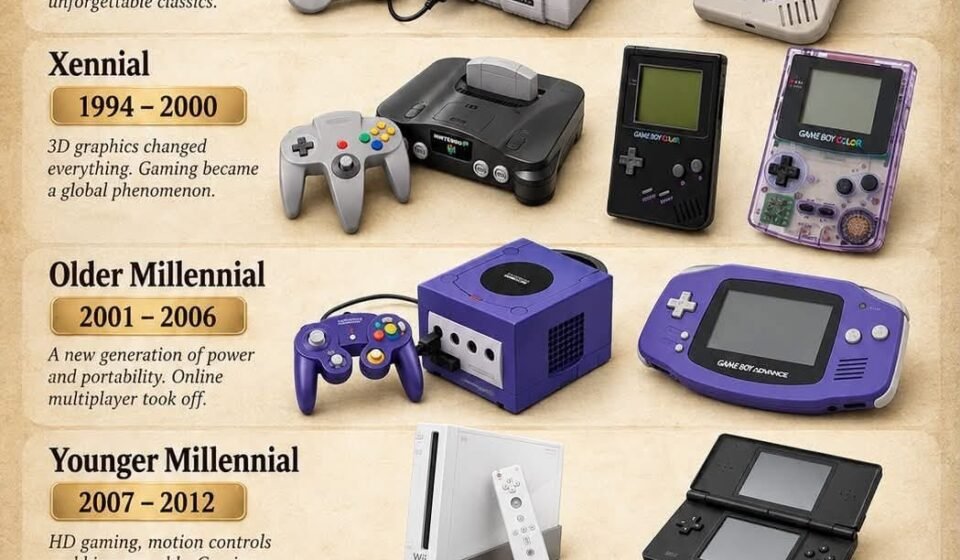

Video game consoles have changed dramatically since the first home gaming systems appeared. What started with simple machines that could display basic shapes and colors has developed into powerful entertainment devices capable of producing detailed worlds, online multiplayer experiences, digital games, streaming services, and immersive gaming experiences.
The history of video game consoles is closely connected to the history of gaming itself. Each generation introduced new technologies, new ways to play, and new ideas about what a home video game system could do.
The beginning of home video game consoles
Before modern consoles existed, most electronic games were played on specialized computers or arcade machines.
The idea of bringing video games into people’s homes became more realistic during the 1970s.
One of the earliest important home systems was the Magnavox Odyssey, released in 1972. It allowed players to play simple games on a television.
The system was very different from today’s consoles. Its games had extremely simple visuals, and the hardware had limited capabilities compared with modern systems.
However, it demonstrated that video games could become a form of home entertainment.
The rise of atari
The 1970s saw the growth of arcade gaming, and companies began looking for ways to bring popular arcade-style experiences into homes.
Atari became one of the most recognizable names in early video games.
The Atari 2600, released in 1977, became an important milestone in console history. Instead of being limited to games built directly into the machine, it used interchangeable cartridges.
This meant players could purchase different games and use them on the same console.
The cartridge system helped establish an important part of the home gaming business model.
The video game crash of 1983
The early console market eventually experienced serious problems.
By the early 1980s, the market had become crowded with consoles and games. There were also concerns about game quality and consumer demand.
These factors contributed to the major North American video game crash of 1983.
The market declined significantly, and confidence in home video games was affected.
For a period, it became difficult for companies to convince consumers that video games were a reliable form of entertainment.
The industry would eventually recover, largely through changes in how consoles and games were developed, marketed, and controlled.
Nintendo changes the console market
In the middle of the 1980s, Nintendo became a major force in the console industry.
The Nintendo Entertainment System, commonly known as the NES, was released in North America in 1985.
Nintendo placed strong emphasis on quality control and carefully managed which games were released for its system.
The console also introduced many players to memorable game characters and franchises.
The NES helped restore interest in home console gaming and became one of the most influential systems of its generation.
The console rivalry of the 1990s
During the 1990s, the console industry became increasingly competitive.
Nintendo continued developing its systems while Sega became a major competitor with its Genesis console.
The competition between the two companies helped create a period of rapid development in gaming.
Consoles became more powerful, games became larger, and developers experimented with new types of gameplay.
The introduction of more advanced hardware also prepared the industry for a major technological change.
The move from 2d to 3d gaming
One of the biggest changes in console history was the transition from primarily two-dimensional games to three-dimensional experiences.
The 1990s saw consoles gain the ability to display increasingly sophisticated 3D graphics.
Sony’s PlayStation, released in 1994 in Japan and later in other regions, became a major part of this transition.
Nintendo also entered the 3D era with the Nintendo 64.
Three-dimensional environments changed how developers designed games. Players could explore spaces from new perspectives, and characters could move through more complex environments.
This transformation influenced many genres, including action, adventure, racing, platform, and role-playing games.
The playstation 2 era
The PlayStation 2 was released around the beginning of the 2000s and became one of the most successful home consoles ever produced.
It offered improved graphics and processing power compared with the previous generation.
One feature that made it particularly useful as a home entertainment device was its ability to play DVDs.
At the same time, developers were creating increasingly ambitious games with larger environments, more detailed characters, improved sound, and longer stories.
The PlayStation 2 era demonstrated that consoles could become more than machines designed only for playing games.
Microsoft’s entry into console gaming
Microsoft entered the console market with the original Xbox in 2001.
The Xbox introduced competition against established companies and brought new hardware capabilities to the market.
One of its important developments was Xbox Live, which helped popularize online console gaming.
Players could connect to the internet and participate in multiplayer experiences with other people.
Online gaming would become an increasingly important part of the console industry during the following generations.
The rise of online gaming
Earlier consoles primarily focused on local multiplayer or single-player experiences.
As internet connections became more common, consoles increasingly incorporated online services.
Players could compete with people in other locations, communicate with friends, download games, and receive updates.
Online connectivity changed the relationship between players and their consoles.
Games were no longer necessarily finished products that remained unchanged after purchase. Developers could continue improving them and adding new content.
The nintendo wii and motion controls
Nintendo took a different approach with the Wii, released in 2006.
Instead of focusing only on increasing graphical power, Nintendo emphasized motion-based controls.
The Wii Remote allowed players to interact with games using physical movements.
This helped attract people who did not traditionally consider themselves regular video game players.
Games involving sports, fitness-style activities, party experiences, and simple controls became particularly popular on the system.
The Wii showed that innovation in gaming could involve the way players interacted with games, not just better graphics.
The xbox 360 and playstation 3 generation
The Xbox 360 and PlayStation 3 represented another major technological step.
These consoles offered significantly improved graphics and stronger online capabilities.
Digital downloads also became increasingly important.
Instead of purchasing every game on a physical disc, players could purchase and download games directly through online stores.
The PlayStation 3 also introduced Blu-ray support, while the Xbox 360 developed a strong online ecosystem.
This generation helped establish many features that would become standard in future consoles.
The playstation 4 and xbox one
The next generation continued the shift toward connected gaming.
The PlayStation 4 and Xbox One were released in 2013.
Both systems offered improved hardware, online services, digital stores, streaming capabilities, and social features.
Sharing gameplay became easier, and players could interact with friends through online networks.
The importance of digital game purchases also continued to increase.
Developers increasingly supported games with downloadable content, patches, updates, and other post-release features.
The nintendo switch changes the idea of a console
Nintendo introduced another major concept with the Nintendo Switch in 2017.
The Switch was designed to work both as a home console and as a portable gaming system.
Players could connect it to a television or use it as a handheld device.
This hybrid design offered flexibility that traditional home consoles did not provide.
The popularity of the concept demonstrated that players could value convenience and flexibility just as much as raw hardware performance.
The current console generation
Modern consoles have become extremely powerful compared with earlier systems.
The PlayStation 5 and Xbox Series X and Series S represent the current generation from Sony and Microsoft.
These systems offer faster loading, improved graphics, advanced processing capabilities, and strong digital ecosystems.
Solid-state storage has also helped reduce loading times in many games.
Modern consoles can support highly detailed environments, sophisticated lighting, large game worlds, and complex simulations.
Digital gaming has changed everything
One of the biggest changes in console history is the move from physical games toward digital distribution.
In the past, players usually needed to visit a store and purchase a cartridge, disc, or other physical format.
Today, players can purchase many games directly through a console’s online store.
Digital distribution makes it possible to download games without waiting for a physical copy.
It also allows developers to distribute updates, expansions, and other content more easily.
Physical games have not completely disappeared, but digital gaming has become an important part of the industry.
Subscription services
Modern consoles have also introduced subscription-based gaming services.
These services can provide access to collections of games for a recurring fee.
Some subscriptions also include online multiplayer features, discounts, cloud saves, or other benefits.
Subscription models have changed how some players discover and access games.
Instead of purchasing every game individually, players can sometimes explore a large library through a subscription.
Consoles are now entertainment centers
Modern consoles can do much more than play games.
Depending on the system and region, players can use consoles to access video streaming, music, online services, communication features, and other forms of entertainment.
This is very different from the early consoles of the 1970s and 1980s.
A modern console can function as a central entertainment device connected to a television and the internet.
How graphics have improved
The improvement in graphics is one of the easiest ways to see how consoles have evolved.
Early games used simple shapes and limited colors.
Later generations introduced sprites with greater detail, improved animation, and more colors.
Eventually, consoles moved into fully 3D environments.
Modern systems can produce highly detailed characters, realistic lighting, large environments, complex particle effects, and advanced animation.
However, better graphics are only one part of the evolution of gaming.
Developers have also improved artificial intelligence, physics, sound, storytelling, online systems, and gameplay mechanics.
Controllers have evolved too
Controllers have changed significantly over the decades.
Early systems used simple joysticks and buttons.
As games became more complex, controllers gained additional buttons and improved directional controls.
Modern controllers can include analog sticks, vibration or haptic feedback, motion sensors, touch-sensitive surfaces, microphones, and other features depending on the system.
These developments have allowed games to offer increasingly complex control systems.
The future of consoles
The future of video game consoles is likely to continue developing alongside broader gaming technology.
Cloud gaming could reduce the need for powerful hardware in some situations.
Virtual reality and other immersive technologies could also influence how people interact with games.
Artificial intelligence may contribute to game development and potentially create more dynamic experiences.
At the same time, traditional consoles are likely to continue evolving as hardware becomes faster and more efficient.
The relationship between consoles, PCs, mobile devices, and cloud services may also become increasingly connected.
From simple machines to powerful gaming systems
The history of video game consoles is a story of constant technological change.
Early systems introduced the basic idea of playing electronic games at home. Later generations brought interchangeable cartridges, improved graphics, 3D environments, online multiplayer, digital distribution, motion controls, portable gaming, and powerful connected systems.
Each generation built on ideas from the previous one while introducing new ways for people to experience games.
What began as simple electronic entertainment has developed into a global form of interactive entertainment supported by advanced hardware, software, online services, and creative communities.