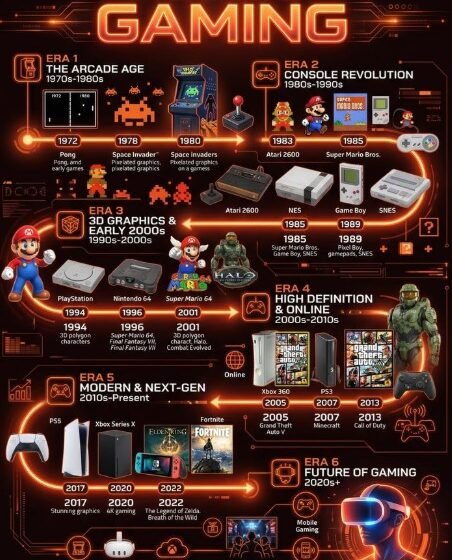

The evolution of video games is the story of how simple electronic experiments developed into a massive global form of entertainment. Video games have changed dramatically in their graphics, technology, gameplay, and the ways people play them.
1. The Early Beginnings: 1950s–1960s
The earliest video games were created mainly as experiments by scientists and universities. One famous example was Tennis for Two, created in 1958 by physicist William Higinbotham. It displayed a simple tennis-like game on an oscilloscope.
In 1962, Spacewar! was developed at MIT. It allowed two players to control spaceships and battle each other on a computer screen. Although these early games were not commercial products, they demonstrated the potential of interactive computer entertainment.
2. The Birth of the Arcade Era: 1970s
The 1970s brought video games to a much larger audience. Arcade machines began appearing in entertainment centers, restaurants, and other public places.
One of the most important developments was Pong, released by Atari in 1972. Its simple table-tennis gameplay became extremely popular and helped establish the commercial video-game industry.
During this period, companies also began producing dedicated home gaming systems. The Magnavox Odyssey, released in 1972, was one of the first home video-game consoles.
3. The Golden Age of Arcades: Late 1970s–1980s
Arcade gaming became a major cultural phenomenon. Games such as Space Invaders, Pac-Man, Donkey Kong, and Galaga attracted millions of players.Home consoles also became increasingly popular. The Nintendo Entertainment System (NES) helped revive the home-console market after the video-game crash of 1983. Characters such as Mario became recognizable around the world.
4. The Rise of 16-Bit Gaming: Late 1980s–1990s
Technology improved rapidly during the late 1980s and 1990s. Consoles could display better graphics, more colors, improved sound, and more complex gameplay.
The Super Nintendo Entertainment System (SNES) and Sega Genesis became major competitors. Games such as Super Mario World, Sonic the Hedgehog, and The Legend of Zelda demonstrated how video games could offer increasingly detailed worlds and stories.
This period also saw the transition from 2D graphics toward 3D gaming.
5. The 3D Revolution: 1990s
The 1990s were a turning point. Powerful hardware allowed developers to create fully 3D environments.
The Sony PlayStation, Nintendo 64, and other systems helped popularize 3D games. Titles such as Super Mario 64, Final Fantasy VII, and The Legend of Zelda: Ocarina of Time showed how games could create large environments and more cinematic experiences.
PC gaming also became increasingly important, particularly with genres such as first-person shooters, strategy games, and role-playing games.
6. Online Gaming: Late 1990s–2000s
As internet connections became more common, gaming began moving beyond single-player and local multiplayer experiences.
Players could compete and communicate with people around the world. Online games such as Counter-Strike, World of Warcraft, and Halo 2 helped establish online multiplayer as a major part of gaming.
Digital distribution also began changing how games were purchased and updated.
7. Mobile and Casual Gaming: 2000s–2010s
The spread of smartphones created another major change. Games were no longer limited to dedicated consoles and computers.
Simple mobile games became accessible to billions of people. The release of smartphones and app stores made it easy for people to download games directly to their devices.
Games such as Angry Birds, Candy Crush Saga, and Clash of Clans introduced gaming to many people who did not traditionally consider themselves gamers.
8. Modern Gaming: 2010s–2020s
Modern video games combine advanced graphics, online connectivity, artificial intelligence, large open worlds, and sophisticated storytelling.Games can now contain enormous environments, realistic lighting, detailed characters, voice acting, and complex physics. Online communities have also become an important part of gaming culture.
Virtual reality (VR) and augmented reality (AR) introduced new ways to interact with digital environments. Cloud gaming has also made it possible to stream some games without relying entirely on powerful local hardware.
9. The Future of Video Games
The evolution of video games is continuing. Developers are exploring artificial intelligence, cloud technology, virtual reality, augmented reality, and increasingly sophisticated game worlds.
Games are also becoming more social. Players can communicate, compete, cooperate, create content, and participate in large online communities.